Matter
and memory
Every home is crossed by flows, pathways and permanence.
There are moments of gathering, intervals of retreat, the objects that accompany the routine and the spaces that host the rituals built over time.
Architecture arises precisely from the articulation between these layers, transforming everyday habits into living experiences.


Click on the images to see the complete project.

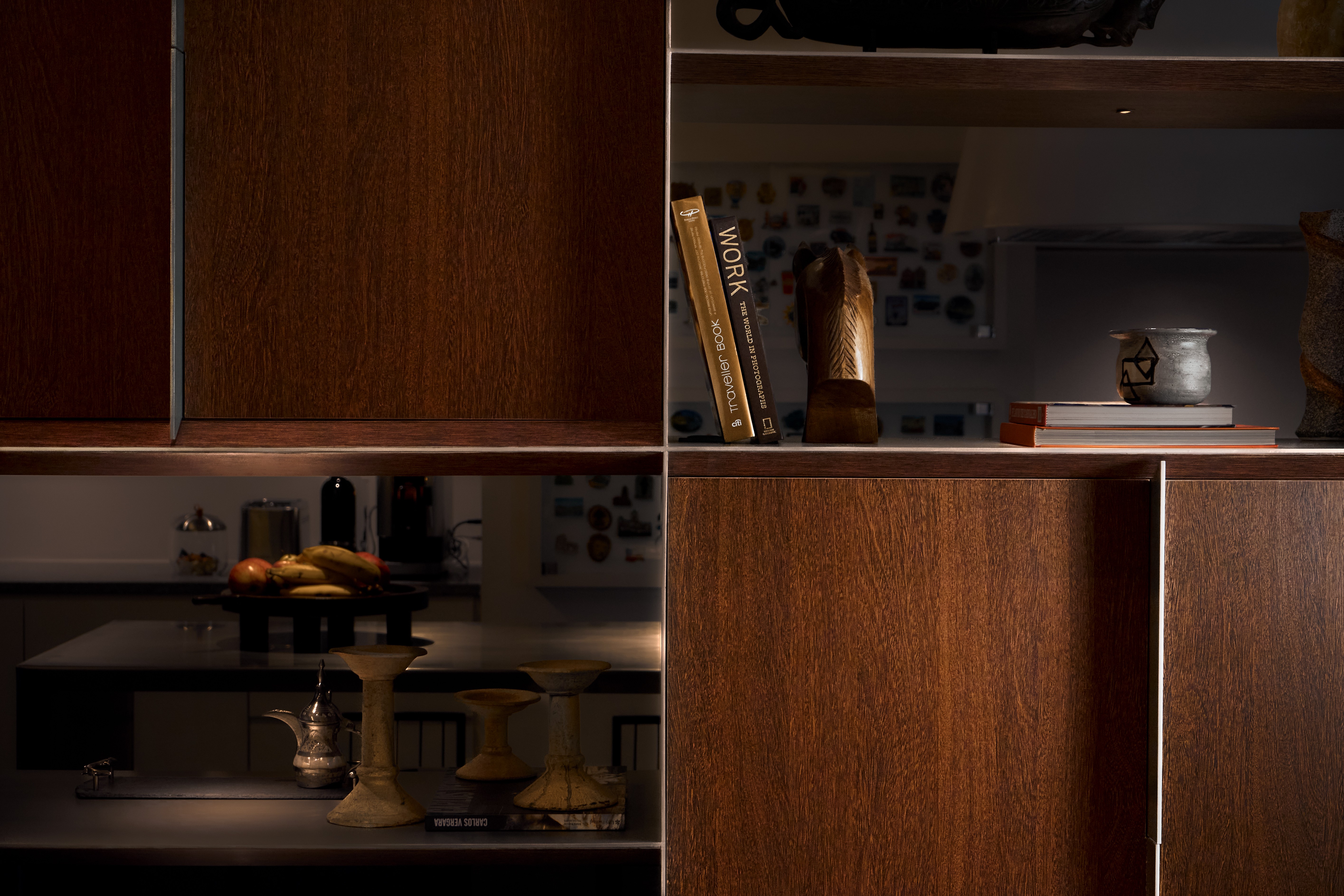

This silent construction sustains an expressive amount of information. Books accumulated over decades, works of art, objects brought back from travels, inherited pieces and new acquisitions coexist within the same domestic landscape.
The project needed to find a measure capable of accommodating this repertoire without turning it into excess.

The grey stone was decisive in this process. Its constant presence offers visual stability for the house and guides other material choices. Stainless steel approaches this same chromatic family, while sucupira wood introduces density and warmth.

Among them, clear planes create pauses and allow objects, artworks, and furniture to find space to exist.

The composition extends to the furniture. The choices do not follow a single formal language, but share an affinity built by proportion, matter and presence. Precisely designed pieces coexist with curved shapes and more organic volumes.
This coexistence prevents the alignments from turning into rigidity of the experience in the space.

When walking through Clodomiro, one's gaze constantly alternates between different scales of observation. At certain moments, it meets the precision of the joints between materials and the careful design of the fittings. At others, it rests upon a sculpture, a painting, a stack of books, or a souvenir brought from elsewhere.

This condition also appears in the relation with the urban landscape.
The view actively participates in the experience of the environments. The geometry of the neighbouring buildings, the variation of light throughout the day, and the constant presence of the metropolis expand an atmosphere marked by controlled contrasts, mineral surfaces, and a certain urban density that runs through the project without becoming literal.